The subtitle is Healthcare Solutions for America and the author is John Goodman (2015). It represents a super-slimmed down version of the author’s earlier book, with some updates to reflect upon the few years since the Affordable Care Act became a reality. His overall view, that the policy regime is terribly flawed, has not changed. Mostly because the anticipated problems were not misdiagnosed or just simply outgrown.
The place to start is that there is a difference between health insurance and actual health care. While the demand for coverage may exist, the supply is not going to increase in tandem unless incentives exist. That alone puts upward pressure on pricing. But, add to that, the government subsidies are capped to grow with GDP, while the actual anticipated costs of healthcare are expected to grow at nearly twice that rate. Over time, the burden shifts to ordinary citizens, making it very expensive.
In addition, when one looks at the quality of insurance that can be purchased through the health care exchanges, what the new cohort of insured will get largely resembles Medicaid or Medicaid Plus. But, recent studies have shown that there are no differences in outcomes for those covered by Medicaid versus the uninsured who simply show up at an emergency room. The mandate, though, means more people will sign up, and that largely means demand will grow from the newly insured, but not necessarily the quality that they will be getting.
As far as the impact on employment, it should shock no one that there is far greater job growth for part-timers over full-timers since ACA implementation, mostly because of the rules around workers who are above or below 30 hours per week having to be covered by employers. Moreover, the ACA also impacts businesses above a certain number of employees, and will aggregate several different businesses for purposes of a head count where there is a common owner – talk about dis-incentivizing entrepreneurs. All of these phenomena were corroborated by surveys conducted by regional Fed banks of the businesses within their jurisdictions.
The requirements around community rating also impact the quality of health plans. Specifically, because the government does not allow insurance companies to underwrite for actuarial risk in the plans that they can offer on the exchanges, they have no choice but to create plans that attract the healthy over the sick, whether through a narrow network of doctors included, or simply making the costs of non-discretionary health measures higher (meaning the healthy are less sensitive than the sick to the potential economic costs). So, yes, people may tout that premiums are lower, but that’s in large part because plans are skimpy.
Goodman continues to believe that a more market-based and transparent approach to the pricing of health care would be a major step in improving it. He is also a big believer in tax credits and portability.
Anyway, the problems are what they are. We will see what El Presidente does in his effort to overhaul and repeal.
Showing posts with label Health Care. Show all posts
Showing posts with label Health Care. Show all posts
Thursday, February 23, 2017
Wednesday, May 7, 2014
Obamacare and Jobs
Courtesy of John Mauldin, I read an interesting piece by Rich Yamarone at Bloomberg that does a good job of explaining how weak payroll reports should be viewed as an anticipated symptom of Obamacare.
Under the health care law, if an employee works more than 30 hours per week an employer has to offer coverage. So when you parse through the jobs data and see that the biggest increases have come in the retail and hospitality sectors, suddenly it makes sense. A restaurant chain has a lot of employees and does not want to incur that insurance expense – so they reduce weekly hours to less than 30 per employee, and make up for it by hiring more people, while still saving on the bottom line because they fall within the ACA exemption. Simultaneously, without these new low-paying jobs, the payroll reports would look a lot more dismal.
Basically, don’t misconstrue the “strong” job growth.

Wednesday, April 30, 2014
Interesting Things
-Thank goodness for Obamacare. Whoever said “G” isn’t important to national output?!
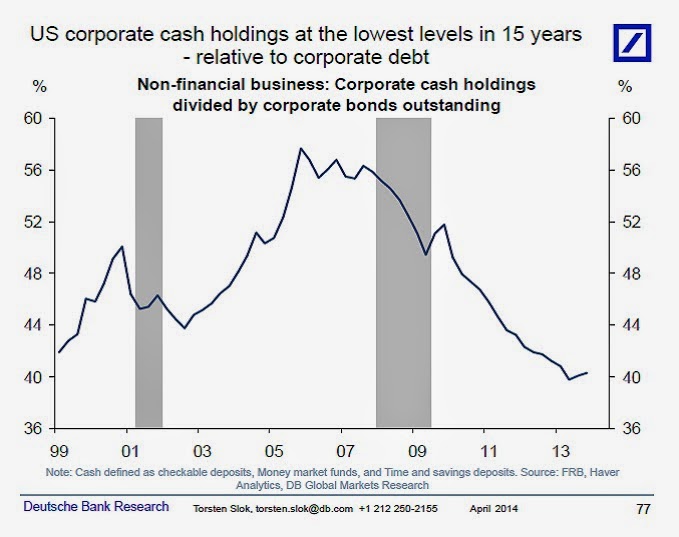
-I liked this FRBNY chart (h/t Marc Faber):

-I’ve said it before, I’ll say it again. You can’t just look at the asset side of the balance sheet…
-This is what a “failed rally” looks like… (h/t Fleck)

-“Every act of conscious learning requires the willingness to suffer an injury to one’s self-esteem. That is why young children, before they are aware of their own self-importance, learn so easily; and why older persons, especially if vain or important, cannot learn at all.” –Thomas Szasz (h/t Marc Faber)
-“…agonies notwithstanding, I do not believe in mistakes. I believe that we all go through some very bad experiences and that the only mistake we can make is to fall down and to stay down.” – Marc Faber
-I liked this FRBNY chart (h/t Marc Faber):
-I’ve said it before, I’ll say it again. You can’t just look at the asset side of the balance sheet…
-This is what a “failed rally” looks like… (h/t Fleck)
-“Every act of conscious learning requires the willingness to suffer an injury to one’s self-esteem. That is why young children, before they are aware of their own self-importance, learn so easily; and why older persons, especially if vain or important, cannot learn at all.” –Thomas Szasz (h/t Marc Faber)
-“…agonies notwithstanding, I do not believe in mistakes. I believe that we all go through some very bad experiences and that the only mistake we can make is to fall down and to stay down.” – Marc Faber
Wednesday, February 12, 2014
Still Here
I have been focused on other things lately, leading to no new posts in quite a while. I am working towards a goal and it takes up a lot of time, but satisfying time at that. Nevertheless, I did want to mention a couple of things that I’ve read recently that were interesting:
-First up is a blog post that talks about the experiences of two entrepreneurs who started a real estate investment shop about 4 years ago while still in grad school. It has now grown to a $400M portfolio. I imagine there might be some lessons in there for someone like me.
-From The Real Deal, with the condo boom in the City and other conversions going on, the stock of Class B office in Manhattan has been on the decline. Which means such assets make for a compelling investment simply on the basis of supply and demand.
-John Mauldin takes time in his weekly piece to examine the recent CBO report about Obamacare, and how the legislation will likely lead to people working less, given the taxes that will function as a disincentive. So, for those concerned about wage stagnation relative to productivity, get ready for it to become even more pronounced. Which means a drop in GDP – which, by the way, means a drop in tax revenues to pay for the government. So much for smaller deficits.
Friday, December 20, 2013
Links
I think Alasdair Macleod provides an interesting take on the taper announcement. To wit:
-The reduction was a token amount and the fact that it sliced away at MBS and Treasuries equally suggests that the decision was one to “pluck a figure out of the air”
-Even if the QE policy was reduced in scope, the commitment to ZIRP remains. And, therefore, implicitly a commitment to providing as much liquidity as needed to keep rates suppressed. Doesn’t that make the two policy announcements a bit contradictory? Or, better yet, QE meaningless in the context of whether or not the Fed must continue to be out in the market buying and selling lots of securities?
Here’s another interesting link – the gold ain’t there.
Speaking of Obamacare, one more requirement has been waved by fiat – namely, the deadline for people who had policies cancelled to sign up or else endure a penalty. This thing is becoming the disaster that keeps on giving. But, the best part is the closing line of a very snarky article: “And the punchline: With only days before the Monday deadline to sign up for coverage that starts Jan. 1, insurers are facing a much smaller, and sicker, pool of customers than hoped for. Like we said: anything that can go wrong... oh look, over there, the Stalingrad & Propaganda 500 just hit a new all time high!”
In Mark Hanson’s latest, he lays to waste the idea that housing is more affordable now than it was during the bubble years since rates are lower and prices are still beneath the highs. The reality is that the exotic financing of yesteryear that allowed people to buy with no money down and no income is gone. Today, the great majority are doing 30-year fixed terms, and the monthly payments are about as high as they have ever been. Factor in at least 20% down, and you should ignore the prior highs on Case-Schiller as to where things could go.
Friday, December 6, 2013
More on the health care mess
Perhaps I seek it out, but I found this piece from Charles Hugh Smith to be a well-done criticism of Obamacare. Not that it necessarily covers new ground, but it does include some anecdotal evidence of how costs are not going down for consumers for the same or an inferior product. He basically compares his own plan currently, as a self-employed individual, with the equivalent on the exchange and finds higher premiums, out-of-pocket caps and co-pays for the ACA offering. And in looking at the cheaper options, deductibles march even higher.
Next I take you to John Goodman’s blog (he of the book Priceless that I read last year) where he notes that the people signing up for the exchanges are weighing heavily towards the elderly and higher risk profile candidates. Remember, the ACA requires young, healthy people to sign-up in order to keep the program’s costs down. So far, it isn’t working out that way. The upshot is that the government will have to pay out more to the insurers to cover losses, and the insurers themselves will be motivated to raise premiums over time.
Next I take you to John Goodman’s blog (he of the book Priceless that I read last year) where he notes that the people signing up for the exchanges are weighing heavily towards the elderly and higher risk profile candidates. Remember, the ACA requires young, healthy people to sign-up in order to keep the program’s costs down. So far, it isn’t working out that way. The upshot is that the government will have to pay out more to the insurers to cover losses, and the insurers themselves will be motivated to raise premiums over time.
Thursday, November 14, 2013
Small Bites
A few things that I noticed around the internet…
-I liked this article by Bob Murphy that examines the economic problems with Obamacare and why we are headed for a single payer and medical rationing down the road.
-Here’s a piece where Scott Sumner responds to the WSJ op-ed by Andrew Huszar from earlier this week. As you’ll recall, Sumner is a fan of NGDP targeting and supports the large-scale QE programs. But when he writes the following…
“Huszar doesn’t seem to realize that financial-market reactions are the best indication of how these programs are working, indeed the only reliable indication. Everything else (such as borrowing costs) is meaningless without a counterfactual.”
…does anyone else see some inconsistencies in logic? I mean, if it’s really about aggregate demand and GDP growth, why have both metrics continued to stall even as the QE programs have gotten larger? In fact, the financial markets have shown little to no correlation with economic realities.
-Moving on to Japan, this Bloomberg article examines how the BOJ has basically overwhelmed the JGB market and that pricing signals have essentially disappeared. For which there are definite consequences:
“’The JGB market is dead with only the BOJ driving bond prices,” said Tetsuya Miura, the chief bond strategist at Tokyo-based Mizuho, one of the 23 primary dealers obliged to bid at government auctions. “These low yields are responsible for the lack of fiscal reform in the face of Japan’s worsening finances. Policy makers think they can keep borrowing without problems.’”
Friday, November 1, 2013
Around the Web
-I read Scott Sumner’s blog today and he has a new post about reforms to the healthcare system that marry well with the good ideas in David Goldhill’s book. Specifically, the main reform should be to provide everyone with a health savings account and then insurance (perhaps even a single payer) for catastrophic events. It brings in market concepts (as individuals have to be thoughtful about spending for the non-existential stuff) and yet still satisfies those who endorse state intervention and an end to private insurance.
-Speaking of Sumner, he gets credit for pointing out that fiscal stimulus is not a game-changer in the way that some would like us to believe. Specifically, the Fed is always in a position to temper the fiscal side through its conduct of monetary policy and manipulation of rates. In other words, the Fed is much more important. Which then got me thinking about the counter-argument, which is that while the Fed can print money, it ultimately has no control over its velocity. In other words, they can only play defense. Both sides agree, though, that expectations are very important.
So, what do I think? I continue to read a lot of people who believe in a deflationary threat. But, in that battle between inflation and deflation, the Fed always gets another turn at bat. So, if it’s inflation they want, it’s inflation they’ll get. But, how do you work through the issue of velocity?
And here’s where the ephemeral “expectations” piece matters. As we continue to struggle through a low growth, weak employment world, two things should eventually happen: (1) people will realize that the Fed does not have a handle on things and is trapped in the current policy stance; and (2) as the desired results continue to be elusive, the Fed will amp up (rather than taper) its efforts. Between those two realities, dynamics will change as well as the expectations for inflation. And the Fed won’t be able to do a thing about it, unless they are finally prepared to enable the recession/depression that they have tried so hard to prevent.
Wednesday, October 9, 2013
ACA
I have been trying to read articles on Obamacare that I think do a good job of explaining the health care exchanges and other attending consequences and realities.
Let’s start with David Goldhill, the guy who wrote the fantastic book Catastrophic Care. He believes that the exchanges will ultimately lead to higher health care costs. Because insurance companies are not able to underwrite policies for the exchanges in the same manner as before, and have to offer the same price to all customers regardless of individual risk profiles, they are going to err towards higher premiums in order to create a margin of safety. And while the idea may have been that there will be some form of competition amongst providers on the exchanges, Goldhill notes that the very transparency which is beneficial to consumers will also make it much easier for insurance companies to collude on the price of coverage.
As for his coup de grace, he points out that subsidies (for those that don’t get insurance at work and make between 100% and 400% of the federal poverty level – the core demographic for these exchanges) will make many consumers price insensitive rather than frugal bargain hunters. Basically, the amount of premium paid is capped while the subsidy is not. Add to that, insurance companies will have to put at least 80% of premiums collected towards health care or else pay a refund – again, the companies will be extra incentivized to spend so that they can keep a 20% profit share from premiums that is larger.
Separately, Bill Fleckenstein provided some general comments from a friend last week about the Affordable Care Act with the start of open enrollment. Here’s the upshot: the penalties for not getting insurance are still a pittance relative to the monthly premiums, even for the cheapest plans, and the out-of-pocket deductibles are enormous as well. Getting healthy people to sign up (i.e., young and poor), in order to subsidize the sicker amongst us, is going to be a challenge.
None of this bodes well.
Tuesday, August 6, 2013
Interesting Reads
Every day I get emails with interesting stuff to read, most of it comes courtesy of Ed Steers at Casey Research, who does his own aggregation that I sometimes borrow from. Here’s what hit my inbox today…
-An article about the capital losses that the Fed would incur if it had to mark its Treasury portfolio to market. Of course, it’s an academic exercise since the Fed can just print more money…until it isn’t. And the notion that it would ever unwind its balance sheet seems like a laughable proposition anyway.
-The NY Times reports on the precarious fiscal situation in Chicago as a result of underfunded public pension plans. Again, why does GDP focus on the promise?
-You’ve heard about the strikes and violence in South Africa by mine workers and unions. This article details the recent move in Kenya to revoke certain licenses so the government can get a bigger piece of the revenue stream. All of which is to say that more regulation and red tape and lower grades are going to increase the cash cost to extract minerals – if they get extracted at all. How is that bad prospectively for commodity prices?
-Zero Hedge presents data on the decrease in exercise amongst Americans this year versus last. They take it in a different direction from where my head went. My interest relates to the general thesis that we will need more and more “health care” over time.
-The weekly commentary from John Hussman does not provide any astounding revelations, but it does offer a good explanation of the dynamics at play, all while invoking Hyman Minsky. Here is a good excerpt: “The central effect of QE is not on the real economy, but on financial speculation. The Fed purchases Treasury and mortgage securities, and creates new base money (currency and bank reserves) as payment. This results in a huge pool of zero-interest assets that someone in the economy has to hold at any given point in time. This zero-interest money is a “hot potato” that creates discomfort and encourages a tendency to “reach for yield” in more speculative assets. Undoubtedly, the universal attention to Fed actions has already created a mob psychology where, to use Kindleberger’s words, ‘virtually each of the participants in the market changes his or her views at the same time and moves as a herd.’”
Wednesday, July 31, 2013
Faber and Obesity
The monthly Marc Faber piece came out today. To get right to the question one might ask, he continues to be constructive on gold, both as a long-term investment and as a relative value to any other asset class right now.
But of more interest to me was his discussion of the fact that the American Medical Association is pushing to have obesity categorized as a disease. Faber finds much to object to, but it primarily relates to the idea that people no longer have to take responsibility for their own behavior and the government is provided with yet another avenue to meddle in our lives. By contrast, I thought about it in terms of the David Goldhill book that I read several months ago. One of the big risks with our growing health care system is that everything eventually gets re-defined as a medical condition, and the consequence is that we end up with an ever-expanding list of items that someone else should pay for. To be succinct, the problem with all the government proposals is an underlying assumption that there is a fixed amount of health care that everyone needs. But, as the AMA move should make clear, when someone else is paying, more and more things will get sucked into the vortex of health care, with rising costs to follow.
But of more interest to me was his discussion of the fact that the American Medical Association is pushing to have obesity categorized as a disease. Faber finds much to object to, but it primarily relates to the idea that people no longer have to take responsibility for their own behavior and the government is provided with yet another avenue to meddle in our lives. By contrast, I thought about it in terms of the David Goldhill book that I read several months ago. One of the big risks with our growing health care system is that everything eventually gets re-defined as a medical condition, and the consequence is that we end up with an ever-expanding list of items that someone else should pay for. To be succinct, the problem with all the government proposals is an underlying assumption that there is a fixed amount of health care that everyone needs. But, as the AMA move should make clear, when someone else is paying, more and more things will get sucked into the vortex of health care, with rising costs to follow.
Thursday, July 18, 2013
The Pending Health Care Problem
A really interesting guest piece on the Casey Research site yesterday...
Hidden Consequences of the Employer Mandate Delay
Obamacare is a hodgepodge of new regulations, requirements, and penalties. I'd like to start by defining three terms which, while obscure today, should begin to enter our everyday vocabulary as Obamacare continues to take effect:
Health insurance exchanges are the basket of qualified insurance policies that meet the new healthcare law requirements for expanded coverage. These may be set up by the states (many are refusing to do so, due to high cost and fear of bankrupting the state) or the federal government. The Exchanges are supposed to be fully operational by October 1, 2013, but it is questionable whether they will actually be in place by that deadline.
The individual mandate requires that individuals purchase health insurance that meets the new, expanded federal requirements. Individuals who do not comply face a financial penalty. Individuals who fall below minimum income levels will be eligible for taxpayer-funded subsidies to buy health insurance.
The employer mandate requires that businesses with more than 50 fulltime employees must provide health insurance for all employees, and that insurance must meet the new standards set forth in the new law. Businesses that do not comply must pay a financial penalty for each employee, which for large companies can run into the millions of dollars annually. This is the piece of Obamacare that has been delayed by one year.
To answer that question, we must first understand this fact: Obama wants a single-payer healthcare system in the US. This is not a secret:
These quotes are not taken out of context. Anyone who has been paying attention knows that transitioning to a single-payer system has been Obama's and his cohorts' ultimate goal all along:
Here, Rep. Schakowsky is suggesting that the "public option" will lead to their desired goal of a single-payer healthcare system. Single-payer proponents no longer use this term, since the public has clearly and consistently opposed it. The "public option" has been renamed "Medicaid expansion," which serves the public-relations purpose of confusing the public and avoiding calling taxpayer-funded healthcare "single payer."
Hacker nicely sums up the underlying goals of Obamacare: not to increase competition or patient choice, but to drive people out of private insurance as a stepping stone to a government-run, single-payer system.
By forcing individuals to purchase compliant healthcare plans but not forcing employers to provide those plans, Obama is creating a swell of 10-13 million workers that must enroll in health insurance, but cannot obtain it from their employers. These workers thus have no choice but to use the government-controlled health insurance exchanges, or else pay a financial penalty. This represents a doubling of the number of workers forced to get health insurance on the exchanges.
Importantly, the IRS has ruled that if workers have access to affordable health insurance through their employer, their dependents are not eligible for taxpayer-funded subsidies on the Obamacare health insurance exchanges. Now that businesses will not be required to offer health insurance until 2015, workers and their dependents will be eligible for taxpayer-funded subsidies to purchase health insurance on the exchanges. This will cost taxpayers an estimated $60 billion dollars in 2014 alone to cover the increased costs of subsidies—and the loss of revenue from employer penalties.
This $60-billion figure is before we take into account the "liar subsidies" that will invariably occur now that the Administration has quietly removed eligibility verification for taxpayer-funded subsidies. Community organizers are already being hired around the country to sign people up for the health exchanges. There are no penalties for failing to verify eligibility, and no penalties for signing up people who cannot afford to pay the monthly insurance premiums. It is set up for disaster, much like the "liar loans" that helped topple the mortgage industry when people were not required to verify their income to qualify for a mortgage.
Remember, by enacting the dual mandates, Obamacare ostensibly was designed to ensure that its costs were borne by businesses, not taxpayers. But when the president decided to enforce only certain portions of the healthcare law and delay others, he shifted the cost of health insurance onto the backs of taxpayers.
This is all on top of the burdensome costs Obamacare has already created. Various studies have projected that private insurance premiums will rise between 20 to 60% in 2014, and some as much as 100%.
How long will the private-insurance market survive with such exploding costs? People will not be able to afford such massive premium increases. That seems to be the point: drive up costs and drive everyone into the arms of government-controlled medical care.
Jeff Smith from Seattle summed it up nicely in a Wall Street Journal letter on June 12:
Americans need to become far more proactive about taking charge of their health. The healthier you are, the less vulnerable you are to our degrading healthcare system. It's also wise to consider proactively planning for medical treatment options outside the US.
Hidden Consequences of the Employer Mandate Delay
By Elizabeth Lee Vliet, M.D.
Obamacare is a hodgepodge of new regulations, requirements, and penalties. I'd like to start by defining three terms which, while obscure today, should begin to enter our everyday vocabulary as Obamacare continues to take effect:
Health insurance exchanges are the basket of qualified insurance policies that meet the new healthcare law requirements for expanded coverage. These may be set up by the states (many are refusing to do so, due to high cost and fear of bankrupting the state) or the federal government. The Exchanges are supposed to be fully operational by October 1, 2013, but it is questionable whether they will actually be in place by that deadline.
The individual mandate requires that individuals purchase health insurance that meets the new, expanded federal requirements. Individuals who do not comply face a financial penalty. Individuals who fall below minimum income levels will be eligible for taxpayer-funded subsidies to buy health insurance.
The employer mandate requires that businesses with more than 50 fulltime employees must provide health insurance for all employees, and that insurance must meet the new standards set forth in the new law. Businesses that do not comply must pay a financial penalty for each employee, which for large companies can run into the millions of dollars annually. This is the piece of Obamacare that has been delayed by one year.
Selective Enforcement
Why delay one component of Obamacare and not the others? More specifically, why delay the employer mandate but not the individual mandate?To answer that question, we must first understand this fact: Obama wants a single-payer healthcare system in the US. This is not a secret:
Barrack Obama, 2003: "I happen to be a proponent of a single-payer healthcare system for America, but as all of you know, we may not get there immediately."
Barrack Obama, 2007: "But I don't think we will be able to eliminate employer-based coverage immediately. There is potentially going to be some transition time."
Rep Jan Schakowsky (D-IL), 2009: "Next to me was a guy from the insurance company who then argued against the public option. He said it would not let private insurance companies compete. A public option would put the private insurance companies out of business and lead to single-payer. My single payer friends, he was right. The man was right!"
Jacob S. Hacker (Yale Professor), 2008: "Someone once said to me this is a Trojan Horse for single payer. It's not a Trojan Horse, right? It's right there! I am telling you. We are going to get there. Over time. Slowly. But we are going to move away from reliance on employer-based health insurance, as we should, but we will do it in a way that we are not going to frighten people into thinking they are going to lose their private insurance. We will give them a choice of public or private insurance when they are in the pool. We are going to let them keep their private insurance as long as their employer continues to provide it."
Stepping Stone to Single-Payer
Knowing Obama and his cohorts' goals, the purpose behind the delay of the employer mandate seems clearer: to hurry the "transition time" away from employer-based health insurance and to a single-payer system.By forcing individuals to purchase compliant healthcare plans but not forcing employers to provide those plans, Obama is creating a swell of 10-13 million workers that must enroll in health insurance, but cannot obtain it from their employers. These workers thus have no choice but to use the government-controlled health insurance exchanges, or else pay a financial penalty. This represents a doubling of the number of workers forced to get health insurance on the exchanges.
Importantly, the IRS has ruled that if workers have access to affordable health insurance through their employer, their dependents are not eligible for taxpayer-funded subsidies on the Obamacare health insurance exchanges. Now that businesses will not be required to offer health insurance until 2015, workers and their dependents will be eligible for taxpayer-funded subsidies to purchase health insurance on the exchanges. This will cost taxpayers an estimated $60 billion dollars in 2014 alone to cover the increased costs of subsidies—and the loss of revenue from employer penalties.
This $60-billion figure is before we take into account the "liar subsidies" that will invariably occur now that the Administration has quietly removed eligibility verification for taxpayer-funded subsidies. Community organizers are already being hired around the country to sign people up for the health exchanges. There are no penalties for failing to verify eligibility, and no penalties for signing up people who cannot afford to pay the monthly insurance premiums. It is set up for disaster, much like the "liar loans" that helped topple the mortgage industry when people were not required to verify their income to qualify for a mortgage.
Remember, by enacting the dual mandates, Obamacare ostensibly was designed to ensure that its costs were borne by businesses, not taxpayers. But when the president decided to enforce only certain portions of the healthcare law and delay others, he shifted the cost of health insurance onto the backs of taxpayers.
This is all on top of the burdensome costs Obamacare has already created. Various studies have projected that private insurance premiums will rise between 20 to 60% in 2014, and some as much as 100%.
How long will the private-insurance market survive with such exploding costs? People will not be able to afford such massive premium increases. That seems to be the point: drive up costs and drive everyone into the arms of government-controlled medical care.
Jeff Smith from Seattle summed it up nicely in a Wall Street Journal letter on June 12:
"I was going to leave my job…to start a business until I shopped around for a healthcare plan: At Group Health, a health-maintenance organization in Seattle, I was given a quote of $842 per month for me and my family. But that would increase to $2,320 starting in January 2014 when Obamacare kicks in—a 276% increase. Why? Because I would be forced to carry coverage I don't want and don't need, such as maternity care. Welcome to the world of socialized medicine, courtesy of the Un-Affordable Care Act."
How Obamacare Affects You and Your Medical Care
The delay in the employer mandate is but one of dozens of negative impacts Obamacare will have on your medical services. As an independent physician, I've been discussing these issues with my patients for the past few years, helping them to prepare for what's ahead. Here the ten most important points that I tell my patients:- Your private insurance premiums will cost more and more each year.
- You will lose the choices and flexibility in health insurance policies that we have had available up until now.
- As reimbursements continue to drop, fewer and fewer doctors will take Medicare (for those 65 and older) or Medicaid (people younger than 65).
- Fewer doctors accepting Medicare and Medicaid causes an increase in wait times for appointments and a decrease in the numbers and types of specialists available on these plans. Consumers would be wise to line up their doctors now.
- Studies from various organizations and states have consistently shown that Medicaid recipients have longer waits for medical care, fewer options for specialists, poorer medical outcomes, and die sooner after surgeries than people with no health insurance at all. Yet an increasing number of Americans will be forced into this second-class medical care.
- As more people enter the taxpayer-funded plans (Medicare and Medicaid) instead of paying for private insurance, the costs to provide this increased medical care and medications will escalate, leading to higher taxes.
- With no eligibility verifications in place, millions of people who are in the US illegally will be able to access taxpayer-funded medical services, making longer lines, longer wait times, and less money available for medical care for American citizens… unless taxes are increased even more.
- Higher expenditures to provide medical services lead to rationing of medical care and treatment options to reduce costs. This is the mandated function of the Independent Payment Advisory Board: to cut costs by deciding which types of medical services to allow… or disallow. If you are denied treatment, you have no appeal of IPAB decisions; you are simply out of luck, and possibly out of life. This is a radical departure from the appeals process required for all private health insurance plans. Further, the IPAB is accountable only to President Obama, and cannot be overridden by Congress or the courts. IPAB is designed to have the final word on your health.
- Under current regulations, if medical care is denied by Medicare, then a patient is not allowed to pay cash to a Medicare-contracted physician or hospital or other health professional. Patients who need medical care that is denied under Medicare or Medicaid will find themselves having to either: 1) look for an independent physician or hospital (quite rare these days); or 2) go outside the USA for treatment.
- Expect a loss of medical privacy. Beginning in 2014, if you participate in government health insurance, your health records will be sent to a centralized federal database, with or without your consent.
Americans need to become far more proactive about taking charge of their health. The healthier you are, the less vulnerable you are to our degrading healthcare system. It's also wise to consider proactively planning for medical treatment options outside the US.
Sunday, February 17, 2013
Catastrophic Care
I never thought I would enjoy a book about the U.S. health care system so much, but David Goldhill writes really well. In Catastrophic Care (2013), he explains why the system is so screwed up and then offers some ideas on how to fix it. He isn’t an economist or doctor, in fact he works in the cable business, but in 2007 his father died as a result of mistakes made while being treated in a NY hospital. This book is his attempt to do something about it. As with the John Goodman book that I wrote about previously, I’m not operating with a knowledge base that allows me to challenge the nuances that Goldhill goes through, but a lot of what he says sounds pretty familiar and intuitively makes a lot of sense. So, without further ado, what follows is a random assortment of Goldhill’s most salient observations:
-The basic problem is not a lack of access to insurance, but insurance itself, which drives overtreatment, cost inflation and mistakes. Health care is not the same thing as health insurance.
-Most of the cost to individuals is disguised. The contribution you make goes beyond premiums. For starters, often an employer is responsible for paying much of an employee’s coverage, meaning the employer will pay a lower salary. Furthermore, everyone with a paycheck pays the Medicare Part A tax; in addition, 20% of the federal budget (and 10% for the states) is health care related, so a large chunk of income taxes goes towards those costs.
-The health care system is one where patients largely expect someone else to pay, so the typical dynamics operating in the market and which compel service providers to offer better quality at lower prices just don’t exist. And as insurance companies are on the hook, they simply turn around and charge higher premiums to compensate for the overtesting and cost inflation that exists.
-With someone else paying, consumers are less apt to question whether a test is really needed and to shop around. Moreover, doctors (and consequently insurers who will charge higher premiums) are only too happy for yet another condition to emerge (think erectile dysfunction) where a new treatment is discovered. Goldhill calls it the growth of chronic conditions and the reclassification of medical definitions. Under these circumstances, eventually everyone gets hit with the diagnosis of some chronic condition that requires treatment – even, if historically, it was something that people just lived with.
-With Medicare, even though seniors only pay a small percentage of costs, the explosion in medical services overall has led to a greater burden as a percentage of total income.
-One criticism of private insurance (versus Medicare or Medicaid) is that administrative costs are much higher. But, by virtue of having lower costs, these public insurers have far less oversight and the degree of fraud is meaningfully greater.
-Medicare is funded in three ways: the payroll tax, monthly premiums paid by seniors, and general government revenues. It is often mentioned that Part A pays for itself through the payroll tax (and in fact generates a surplus). But, since 2007, each year that surplus has been lent out to the rest of the government to pay for our huge deficits – the trust fund is now filled with IOUs. Now, question whether you really think that means public health care has sound financing and is self-sustaining. In 2009, the Medicare trustee estimated the future shortfall to be $36 trillion, and then subsequently acknowledged that it is likely understating what the true cost will be. The mistake, as Goldhill notes, is that the government continually assumes that there is some fixed amount of health care needed, but “need” just keeps growing. And a third party payer system is largely at fault.
-The system has this funky way of paying specialists more than general practitioners, which means the more personalized area of medicine, where there possibly exists an intermediary best placed to correlate all the various symptoms, is paid less and thus finds fewer new doctors entering its ranks.
-The uninsured are usually those most likely to shop around and demand lower pricing for services rendered. Under Obamacare, and the mandate that everyone has to have insurance, these discounted people are suddenly going to be full-priced customers, creating even more health care inflation.
-Obamacare mistakenly assumes that an increase in preventive care will lower overall costs. Except what probably happens is that healthy people, who aren’t at risk in the first place, will end up getting more tests, driving up the expense.
-When pundits talk about it, don’t be misled. Costs in other countries only seem under control when compared with the United States. Globally, no system has managed to keep expenses in check, other than perhaps Singapore which has far less in the way of subsidies.
-Obamacare could very well lead to fewer people with insurance. First off, the penalties on individuals for not buying insurance are de minimis enough to go without until insurance is needed; especially since once you need it, a preexisting condition can no longer be the basis for a denial. Similarly, the penalty on employers for not providing insurance is small enough that the arithmetic makes it cost-efficient to pay a slightly higher salary and to send employees to the health care exchanges. From the standpoint of the private insurers, since they are now blindly bidding on these exchanges for new beneficiaries, without being able to assess risk profiles, they certainly have no incentive to be competitive on what sorts of premiums they offer. How does that bring costs down?
Now on to his suggestions for change. Trying to insure everything makes it much more difficult and expensive to protect against true catastrophes. Goldhill proposes a system where individuals have to pay more out of pocket for the anticipated expenses. If everyone had health savings accounts to pay for preventive care, which receive the same tax advantaged status of employer insurance, people would be cognizant of cost and quality. In addition, insurance’s role would be limited to the truly unforeseen, meaning a higher deductible and lower premiums. In this scenario, we remove the passive third party payer and market forces are allowed to work. There’s more to it, but I guess you’ll have to read the book to find out.
Anyway, a really important work that everyone should read.
Wednesday, February 13, 2013
Talking Health Care
I am in the middle of a really interesting and well-done book about the U.S. health care system called Catastrophic Care by David Goldhill (2013). I plan to do a full write-up when done, but still thought it worthwhile to mention a very important point that Goldhill makes. In the context of insurance, it is really a very recent phenomenon (basically the past 45 years). And in that period is when we have seen the greatest surge in health care inflation. The issue, as Goldhill sees it, is that the insurance companies are in the business of making money through premiums. And they can only really raise premiums if more money is spent on health care in general. So, while they may talk a good game about healthy living and exercise, they are a much happier group if people need doctors and more procedures are approved and need to be administered. For those who then argue that that would imply that the government should become the single payer, tell me in what universe the folks who run Medicare or Medicaid will ever start worrying about efficiencies when they have an unlimited budget and will have to face a little special interest group comprised of all senior citizens if they ever do try to cut back. The end game is higher health care costs. Obamacare largely just added to the base of people that insurance companies will be able to collect premiums from.
More to come.
More to come.
Saturday, October 6, 2012
Priceless
With many subjects under the sun that might be deemed topical, my familiarity with the important minutiae is often minimal. Such is the case with health care policy and the plumbing that makes it such a complicated issue. Seeking to deal with that knowledge shortfall, I picked up Priceless by John Goodman (2012). Goodman is a health economist who espouses a libertarian / free market world view. And while I cannot tell you that his perspective on everything is necessarily accurate, here are some of the details and ideas that I think matter upon reading his book:
-In seeking to create a system with no out-of-pocket expenses for patients, incentives are skewed to overuse the system without much concern for shopping around to find the best service at the lowest cost.
-Having everyone pay the same premium incentivizes the healthy to go without insurance until they are actually in need (as flat premiums create a redistributive effect, where the sick are paying premiums lower than the expected cost of their health care needs, and vice versa for the healthy). And those that are uninsured, generally, are more likely to use emergency rooms, which increases overall costs.
-The world of medical care is largely a system of unpriced services. It is not a market process.
-To quote: “the field has been completely corrupted by the idea that (a) patients should never be in a position to choose between health benefits and monetary cost, (b) doctors shouldn’t have to think about such tradeoffs either, (c) to insulate the patient from having to choose between healthcare and other uses of money, third party payers should pay all the medical bills, and (d) since no one else is going to think about what anything costs, the third-party payer is the only entity left to decide which services are worthwhile and which ones aren’t.”
-There is a supply problem when it comes to care. Grand policy ideas may lead to more people with coverage, but it is not suddenly going to create more doctors to treat them.
-Higher fees often lead to greater access to care. Thus, public programs that don’t allow patients to supplement coverage with out-of-pocket payments (like Medicaid and CHIP) end up decreasing a patient’s ability to see the doctor that he or she needs.
-Where public programs have very specific protocols and guidelines for treatments, there is no incentive / financial benefit to doctors for going outside those boundaries and providing care which is more cost-effective.
-With community rating (same premium for all), insurance is geared to structure its products to encourage only the healthy (by not including certain doctors and specialists).
-Congress favors employer insurance (tax deductible) over individual insurance (deduction only on amount in excess of 7.5% of AGI), meaning it is less portable when people have to move and change jobs. This is where the problem of preexisting conditions often becomes very obvious.
-Data does seem to suggest that every additional dollar put towards public insurance crowds out the private variety.
Goodman spends a bit of time analyzing the provisions of the Patient Protection and Affordable Care Act (“Obamacare”) as well:
-The main way that the ACA plans to lower costs (specifically with respect to Medicare) is by implementing price controls on providers. But, as Goodman notes, the shifting of costs back to doctors is not the same as actually controlling them. If anything, it probably leads to fewer doctors accepting Medicare as a form of payment and making accessibility more difficult. This reality is also why the pro-ACA faction says costs will go down, but perhaps chooses not to recognize that it will take quality and access with it. So, public insurance will provide less, while private insurance will become more expensive.
-Theoretically, everyone will be required to have insurance. But fines associated with going without will be small enough to make it worthwhile to hold off until there is an actual need. Employers will also have to provide plans that meet certain minimum thresholds. But, again, the fines will likely be smaller than the cost of meeting the requirements. So, it seems plausible than many folks will lose their coverage through work.
-There will be a whole host of new taxes to pay for the program (on medical devices, drugs, Cadillac plans, investment income, and raising the AGI threshold for individual insurance), which will add to the costs for individuals.
After reading the book, I don’t have any grand conclusions, except to say that implementation of the best of intentions does not always translate to ideal outcomes. And I suspect that that might be the case with the new law. By coincidence, a blog written by health economists with some left-leaning tendencies also recently reviewed the book chapter-by-chapter, finding much to take issue with. If you’re interested, follow the link.
Subscribe to:
Posts (Atom)